GPT Image 2 vs GPT Image 1.5: What Actually Changed
Nine months after GPT Image 1.5, the follow-up shows up on LM Arena under a tape-themed codename. Here is what is different, what is the same, and what you can reason about today versus what is still rumor.
Nine months after GPT Image 1.5 shipped, a mystery model called maskingtape-alpha started topping the LM Arena image board. That is GPT Image 2 in disguise. You cannot call it on any hosted provider yet, including fal, but the leaked intel gives you enough to plan migrations on.
Here is the delta. No marketing. Just what the model does differently, where the numbers land, and when it actually matters for your product.
The architecture delta
GPT Image 1.5 was stapled onto GPT-4o. You spent a chat-model turn to get an image, which is why p50 latency sat around 12 to 20 seconds for a high-quality 1024x1024. The diffusion step was not the bottleneck. The text-model preamble was.
GPT Image 2 appears to run as a single-pass independent model. You hand it a prompt, it returns pixels. No planner turn in front. Sub-3-second generation at medium quality is the claimed floor, and that lines up with Arena samples.
Practical consequence: the 1.5 cost curve was dominated by chat-side tokens on long prompts. In 2 you pay for pixels. Long prompts get cheaper relative to short ones.
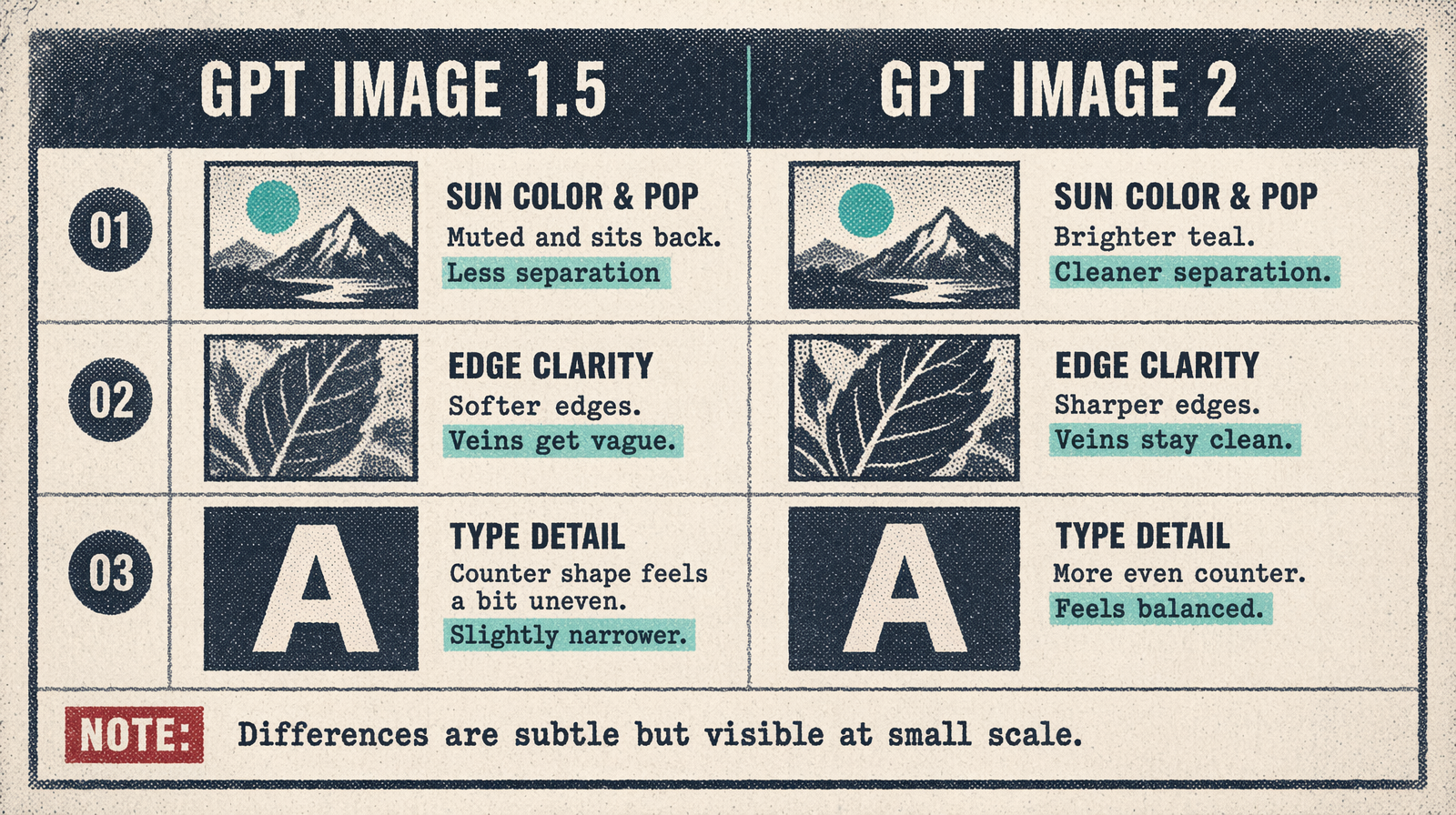
Text rendering
This is the headline. GPT Image 1.5 could render short words if you were careful. Six characters, one font, one line, one color. Past that, you got kerning soup, invented Unicode, or words that read right on first glance and wrong on second.
GPT Image 2 is claimed at over 99 percent glyph accuracy for English, with CJK scripts also solid on Arena. If you believe the number, this is the first model where a paragraph of small-point text on a poster is trustworthy. Not "trust it enough to hide the typos in motion." Trust it at print resolution.
If you ship UI mockups, infographics, or packaging, that is the change that moves the pin.
The yellow cast
Everyone who shipped 1.5 in production knows the yellow. Daylight scenes had a faint amber wash. You could correct it in post with a blue shift, but the model baked it in. Arena reports say GPT Image 2 renders neutral grays as neutral grays. If you are building a catalog tool where color fidelity matters, this alone is enough to plan the upgrade.
Resolution and aspect
GPT Image 1.5 topped out at 1792x1024 with three fixed aspects. GPT Image 2 adds native 2048x2048, a 4K mode, plus 16:9 and 9:16 at full resolution. The 9:16 matters if you ship short-form vertical thumbnails or mobile splash art and do not want to upscale. Expect 4K to be the expensive tier.
Pricing
GPT Image 1.5 is $0.005 to $0.20 per image depending on quality tier and size. Low-quality 1024x1024 is the floor. High-quality 1792x1024 is the ceiling. Most production traffic sits in the $0.04 to $0.08 band on medium tier.
GPT Image 2 is not on fal yet, and OpenAI has not posted a price. Plan for it to land in the same band as GPT Image 1.5 until you see a real price sheet. Budget at 1.5 high-tier rates and you will not be wrong by more than 30 percent either way.
What you can do today
You cannot call GPT Image 2 on fal yet. You can build the migration surface so flipping the endpoint is a one-line change. Here is a generation call against the current flagship, written so the switch will not need any reshaping.
1import { fal } from "@fal-ai/client";23const result = await fal.subscribe("fal-ai/gpt-image-1.5/edit", {4 // or fal-ai/gpt-image-2 once available5 input: {6 prompt: "a matte black aluminum kettle on a concrete countertop, soft window light from the left, 35mm film grain",7 image_urls: ["https://example.com/base.jpg"],8 num_images: 1,9 quality: "medium",10 image_size: "landscape_16_9"11 },12 logs: true13});1415console.log(result.data.images[0].url);
Keep quality and image_size as named options. When Image 2 lands, the new tiers and the 2048 and 4K sizes slot in without touching the rest of your code.
The migration question
Should you wait or ship on 1.5 today? If your product renders text on images, wait. The 1.5 typography is not good enough for production UI, and retrofitting the upgrade will be one API swap. If your product is photographic and text is decorative, ship on 1.5. The speed and cost difference probably will not offset the engineering churn of migrating twice.
If you care about neutral grays: you already know the answer.