GPT Image 2 vs Flux 2 Pro vs Imagen 4: When Each One Wins
Three frontier image models, three strong opinions. A working guide to which one you call for which job, based on what each is actually good at in April 2026.
As of April 2026 you have three plausible defaults for a production image pipeline: OpenAI's GPT Image 2 (arriving, not yet hostable), Black Forest Labs' Flux 2 Pro (shipping, widely hosted), and Google's Imagen 4 (via Vertex and partners). Each wins a different category. Picking by task rather than brand is where the wins live.
The one-sentence version
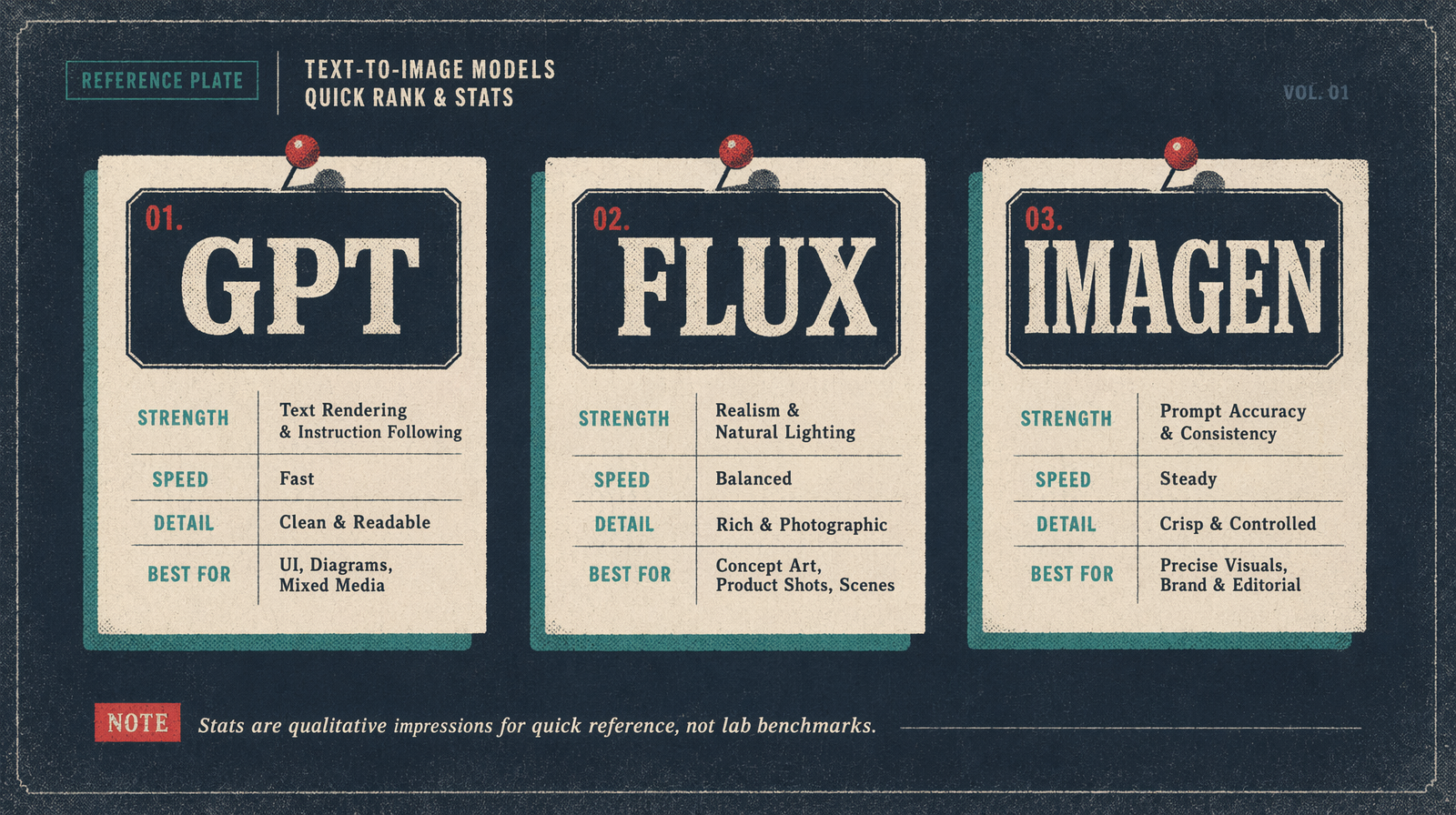
- GPT Image 2: best-in-class text rendering, UI mockups, world-knowledge detail.
- Flux 2 Pro: best raw photographic realism, best prompt adherence, fastest iteration.
- Imagen 4: best for brand-safe marketing with a Google-aesthetic lean.
Stop reading if you needed the shortcut. Keep reading if you want the reasoning.
Text and typography
GPT Image 2 wins outright. The leaked 99 percent glyph accuracy holds up in Arena samples across Latin, CJK, Cyrillic, and Arabic. Flux 2 Pro renders text well up to 15 characters and degrades past that. Imagen 4 is competitive on short headlines but weak on paragraphs and CJK.
For UI mockups, infographics, packaging, or anything where text is content rather than decoration, GPT Image 2 is the default.
Photographic realism
Flux 2 Pro is king. Skin textures, atmospheric haze, how light falls on fabric all feel like a camera captured them. GPT Image 2 improved photo output over 1.5 by killing the yellow cast, but its default still leans slightly stylized. Imagen 4 produces clean commercial photographs that feel stock.
For product photography or editorial shots where the goal is "indistinguishable from a real shoot," Flux 2 Pro wins.
Prompt adherence
Flux 2 Pro has the strongest adherence. Write a nine-clause prompt with color, lighting, lens, depth of field, framing, mood, and an action, and Flux honors every clause. GPT Image 2 simplifies when the prompt gets long. Imagen 4 simplifies the most.
This matters when compositing into an existing design system. You want a model that treats constraints as hard, not as suggestions.
World knowledge
GPT Image 2's claimed edge is world-accurate UI and architectural detail. A login button has semantic conventions, a receipt has a specific layout, the Eiffel Tower has a specific number of sections. Flux 2 Pro is aesthetically stronger but hallucinates product details. Imagen 4 is strong on landmarks thanks to Google's data.
For a plausible app screenshot, receipt, or known building, GPT Image 2 is the call.
Speed
GPT Image 2 claims sub-3 seconds medium tier. Flux 2 Pro is 4 to 6 depending on host. Imagen 4 is 5 to 8. For interactive products, speed drives retention more than quality.
Pricing
GPT Image 1.5 is $0.005 to $0.20 per image depending on quality and size. GPT Image 2 is expected to land in the same band as GPT Image 1.5 with no official number yet.
Flux 2 Pro is $0.04 to $0.08 on fal.ai, with Ultra higher for 4K. Imagen 4 is $0.04 standard on Vertex, $0.08 for Ultra.
Pick on capability, not price, unless you run millions of calls. At scale, Flux 2 Pro is cheapest for photo work and 1.5 low tier is cheapest for thumbnails.
A multiplex pattern
Serious pipelines do not pick one. They route.
1import { fal } from "@fal-ai/client";23type Job = { prompt: string; hasText: boolean; needsPhoto: boolean };45async function routeAndGenerate(job: Job) {6 let endpoint: string;7 if (job.hasText) {8 endpoint = "fal-ai/gpt-image-1.5/edit";9 // or fal-ai/gpt-image-2 once available10 } else {11 endpoint = "fal-ai/flux/dev";12 }13 const result = await fal.subscribe(endpoint, {14 input: {15 prompt: job.prompt,16 image_size: "landscape_16_9",17 num_images: 118 }19 });20 return result.data.images[0].url;21}
Extend the router for Imagen when you have Vertex access. Call shape is nearly identical because fal normalized it. Swapping endpoints is cheap.
What to watch
Image 2 changes the router entry for text-heavy jobs the moment it becomes hostable. Flux 3, rumored for Q3 2026, may reset the photographic bar. Imagen 5 is unconfirmed but Google ships yearly.
Build the pipeline so swapping endpoints is a config change, not a refactor. That is the move that lets you surf the frontier without eating migration tax.
The one thing not to do
Do not lock into a provider for bundled extras you do not need. A free moderation API or storage bucket in exchange for single-model commitment is a bad deal. Capability moves faster than surrounding services. You want 20-minute swaps, not 20-day ones.